
Every day, we are called upon to recover data from all types of storage media:
- Hard drive
- SSD
- NAS server
- RAID server
- Phone
- USB drives
- (micro) SD card
- Tablet
- Magnetic tape
Our Lab therefore pushes the limits and constantly seeks excellence, even the Holy Grail, and to break records! This can mean repairing a complex fault, recovering the largest amount of data, decrypting malware following a hacker attack commonly known as RansomWare, etc.
We know how much, since the constant rise of computing, data has become important nowadays.
When clients, businesses and individuals, turn to Chronodisk, it’s often to “save their life” as they put it, because they have years, even decades, of files with very significant financial and sentimental value to recover.
So we’re going to tell you an extraordinary story, the story of a data recovery carried out in December 2021! A record of 111 Terabytes recovered!

At first glance…
We are contacted by a very upset client. This documentary film producer can no longer access his (NAS) and his files at all.
We first reassure him of our ability to help him and break records, then the client drops off his NAS with us the same day.
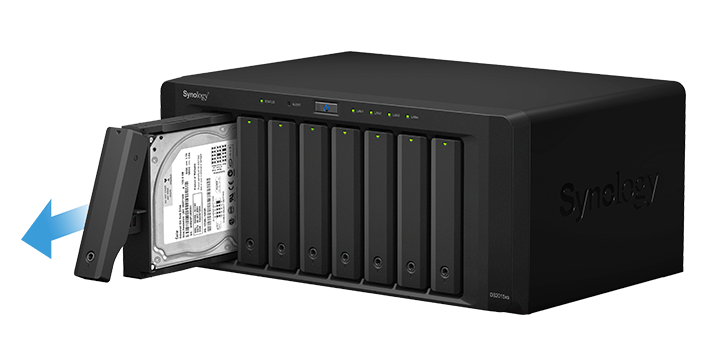
Upon receipt, we find that the Qnap NAS in question is a piece of the client’s DataCenter, in this case a bay of 24 Western Digital hard drives of 12 Terabytes each.
Diagnosis
Our Lab begins with the diagnosis, and the engineer in charge of the case quickly notices the complexity of the situation:
- Nine of the 24 hard drives of 12 Terabytes are faulty with bad sectors. This indicates that the file system may be corrupted, for example, by a power interruption during a write operation on the drive;
- After alerting the Lab Manager, teamwork ultimately reveals that 11 of the 24 hard drives of 12 Terabytes are faulty with bad sectors, one of which also has a mechanical fault;
- The mechanical fault is resolved by finding an identical hard drive to source new parts from;
- Once found, the engineer opens the two hard drives in the cleanroom of our Paris Lab and replaces the faulty parts.
In-depth analysis
After the diagnosis, the crucial step of the data recovery consists of the in-depth analysis of the array of 24 hard drives called RAID.
The technical team, after multiple operations and combinations to determine the order of the hard drives, manages to mount the RAID.
This reconstruction allows us to determine that we are dealing with 2 RAID5 arrays of 12 hard drives each, programmed together.
With the complex equation solved, the engineer launches a full scan of the RAID in order to bring up the directory tree (folder names, subfolders, files, etc.).

A record directory tree of 111 Terabytes appears after a while!
The testing phase can begin to determine the quantity & quality of recoverable data.
111 Terabytes are visible with very good quality!
Once the Chronolist (file listing) is established, we send it to the client for validation.
The client can’t believe his eyes! He validates the Chronolist and orders a new bay of 24 hard drives to receive his data, which will be reintegrated into his DataCenter.
Data recovery
Once the new bay and the 24 hard drives are received, programming the NAS in RAID5 and extracting the data can begin.
Once complete, the new testing phase and extraction of the Chronolist confirmed the accuracy of the one first sent to the client.
All that’s left is for him to come and collect his NAS.
Technical support
Once the NAS was installed at the client’s premises, their managed services company contacted us to help mount the bay on the network at the DataCenter.
After a few exchanges, it worked!
What a great team achievement, praised by the client! 111 Terabytes recovered! Record broken!
Lessons learned
CHRONODISK has the capacity to recover up to 3,000 Terabytes of data with current resources, so we knew that recovering a record of 111 Terabytes was achievable.
The success of these 111 Terabytes saved allowed us to verify that our procedures & methods are indeed well suited to this type of complex work; a few improvements were nonetheless implemented.
The follow-up, providing for regular check-ins with the client based on the progress of the various phases, allowed us to build a relationship of trust.