
Microsoft’s Project Silica marks a revolution in data storage, promising an eco-friendly and durable solution. Using lasers to etch data onto quartz, this cutting-edge technology enables archival-quality preservation over millennia. Already tested successfully on cinematic works, it offers remarkable resistance to extreme conditions. Beyond its durability, Silica is a response to technological obsolescence, ensuring data accessibility despite changing technologies. Although still under development, its potential for various sectors and its contribution to reducing the ecological footprint highlight its importance for the future of digital storage.
Storing data on quartz using lasers
Microsoft is working on an innovative project called Silica, which uses lasers to etch digital data onto quartz. This technology can store up to 7 TB of data on a medium the size of a DVD, capable of lasting 10,000 years without quality loss. This project was first unveiled in 2017 during a Microsoft Ignite keynote on future storage technologies. Today, it has evolved and now offers the ability to store up to 7 TB of data on a quartz plate the size of a CD, for a duration of 10,000 years.
Successful preservation of the 1978 Superman film on a quartz plate
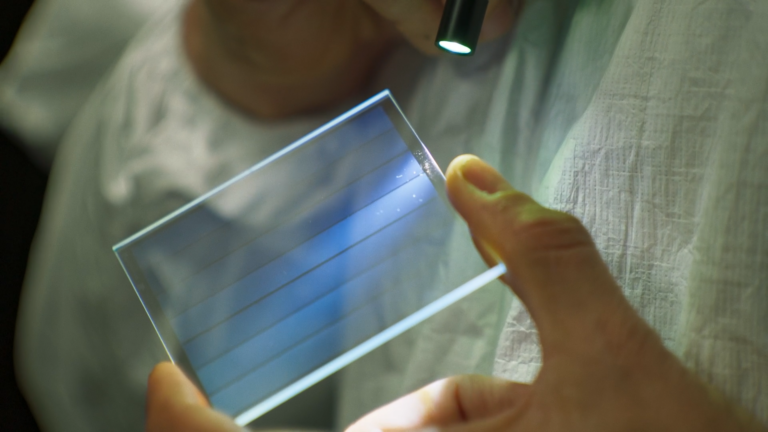
Through collaboration, researchers successfully stored the 1978 Superman film, running 2 hours and 22 minutes, on a quartz plate measuring 7.5 cm on each side and 2 mm thick. This experiment demonstrates the value of Project Silica for preserving artistic works that are often threatened by media aging or natural disasters.
A durable and eco-friendly medium for data storage
One of the main advantages of Project Silica is that it offers a way to store data over the long term without fear of degradation or obsolescence. “You can dunk the piece of silica glass in boiling water, put it in an oven, you can even scratch its surface without it affecting the data it holds,” explains Ant Rowstron, deputy director of Microsoft Research Cambridge. In this way, glass helps reduce the ecological footprint of data storage, which currently represents a significant source of energy consumption and waste production.
A way to bypass technological obsolescence
This medium also avoids the problem of technological obsolescence, which often makes it impossible to read data stored on old or incompatible media. Indeed, as technologies evolve rapidly, it is common for us to no longer be able to access information recorded on aging hard drives or videotapes, for example. Project Silica addresses this difficulty by offering a lasting solution for data preservation, regardless of future technological advances.
Potential applications of Project Silica across various fields
Project Silica is generating strong interest across different sectors. Professionals in film, music, and the arts in general see it as an excellent opportunity to preserve their works for future generations. Similarly, cultural institutions such as museums and libraries could benefit from this technology to efficiently and durably preserve their heritage.
A promising alternative to meet growing data storage needs
The volume of digital data produced and exchanged worldwide keeps increasing. Faced with this exponential growth, traditional storage solutions on hard drive or SSD are showing their limits, both in terms of capacity and durability. Project Silica appears to be a promising alternative for addressing current and future data storage challenges.
Development still underway but already promising
It is important to note that Project Silica is still in its early stages. Microsoft researchers continue their work to improve the technology and make it accessible to as many people as possible. However, the results obtained so far are very encouraging and suggest a promising future for glass-based data storage. If the project’s development continues successfully, it is very likely that in the coming years we will see the rise of a new generation of storage media that is eco-friendly, durable, and suited to the challenges of the 21st century.
Source: Project Silica Microsoft