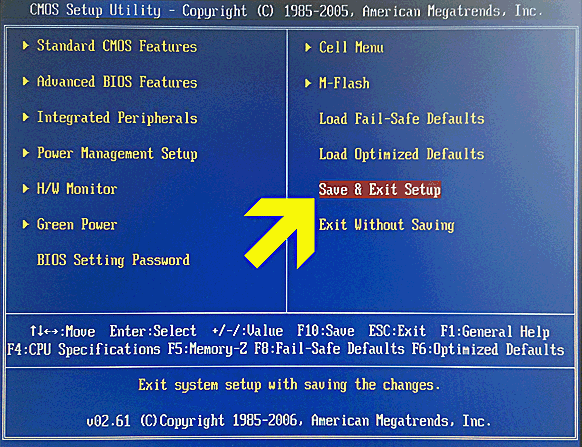
SMART, standing for Self-Monitoring Analysis and Reporting Technology, is a technology that allows a hard drive to be monitored and helps predict a potential upcoming failure. This function attempts to anticipate a failure based on numerous statistical parameters: component temperature, distance between the read head and the magnetic platters, number of attempts required to read a piece of data… SMART is very useful for preventing data loss, but you still need to be able to enable it in the BIOS…

A hard drive can, however, suffer an unpredictable failure. An unpredictable failure would be, for example, an electrical component that suddenly stops working. Obviously, the SMART system would not be able to help in this case. On the other hand, it is generally accepted that 60% of hard drive failures are predictable and that 30% of cases can be detected in advance by this technology. Why go without it?

SMART is not a perfect technology. Indeed, it lacks manufacturing standards, and hard drive manufacturers do not all implement it in the same way. They do not all check the same parameters. Furthermore, it is possible that a motherboard which is theoretically compatible may not be able to communicate properly with a hard drive that is apparently also compatible. It is therefore best to check in advance the actual compatibility of your hard drive and motherboard, as well as to use software capable of properly managing the hard drive you purchased
Note that this technology is constantly evolving. When it was created, it only checked the validity of data requested by the operating system, whereas nowadays it uses the hard drive’s idle periods to validate several other parameters.

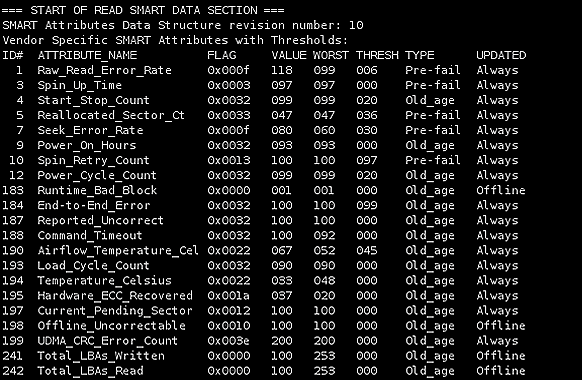
This system still has one last drawback: it reduces hard drive performance. Calculating the hard drive parameters needed for SMART warning messages indeed requires more processing than if SMART were disabled. This is precisely why a computer’s BIOS is often configured by default to disable this technology.